⚠️ FULL STORY SPOILERS WARNING ⚠️
This guide contains complete spoilers including boss fates, character deaths, endings, and major plot twists. Proceed only if you’ve finished Ghost of Yōtei or don’t mind spoilers.
TL;DR – Quick Summary
The Yōtei Six are the main antagonists in Ghost of Yōtei, led by Lord Saito. They massacred protagonist Atsu’s family 16 years ago during the Night of the Burning Tree. The group includes: The Snake (corrupted enforcer, first boss), The Oni (traumatized warlord who killed Atsu’s father), The Kitsune (split between redemption-seeking Oyuki and corrupt successor Dojun), The Spider and Dragon (Saito’s conflicted sons who favor firearms), and Lord Saito (the fallen warlord seeking to become Shogun of the North). Each member represents different aspects of trauma and moral corruption. Players can defeat most members in any order before facing Saito in the final confrontation at Atsu’s childhood home. The narrative explores revenge’s cost and whether redemption is possible for those who commit atrocities.
The Yōtei Six: Quick Reference Table
| Member | Role | Weapon(s) | Key Backstory/Tie to Atsu | Fate |
|---|---|---|---|---|
| Snake | Enforcer | Katana | Opium addict; pinned Atsu to burning tree | Killed first (tutorial boss) |
| Oni (Hyōzō) | General | Odachi (greatsword) | Scarred by young Atsu; killed her father Kengo | Co-op kill with Jubei |
| Kitsune (Oyuki/Dojun) | Spymaster | Poison/kunai | Oyuki showed mercy; Dojun is corrupted successor | Dojun killed; Oyuki redeems herself |
| Dragon | Commander | Matchlock rifle | Saito’s favored firstborn son | Killed by Atsu at Matsumae Castle |
| Spider | Enforcer | Matchlock rifle | Saito’s cowardly second son; staged massacre reenactment | Spared (betrays father to survive) |
| Lord Saito | Supreme Leader | Dual katanas | Exiled warlord who ordered the massacre | Final boss; dies with honor |
Introduction to the Yōtei Six
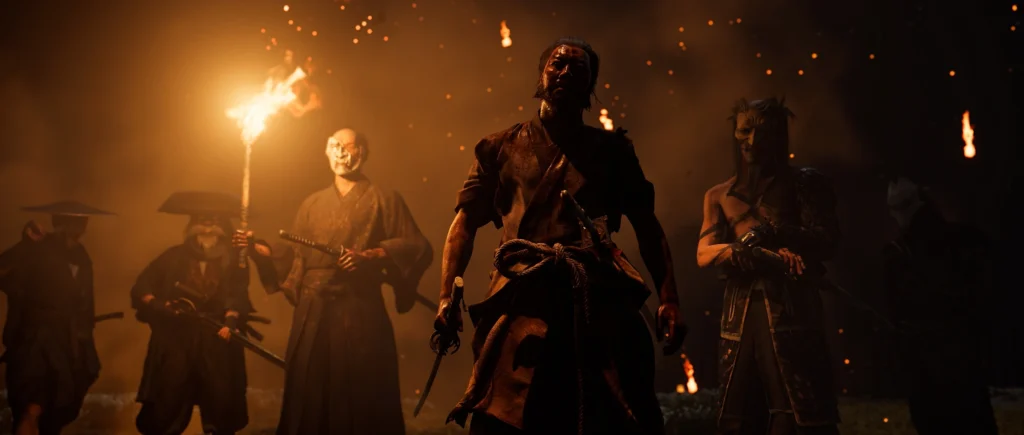
The Yōtei Six stand as the primary antagonists in Ghost of Yōtei (2025), forming one of gaming’s most thematically complex villain organizations. Led by the fallen warlord Lord Saito, this band of six masked outlaws orchestrated the massacre of protagonist Atsu’s family during the Night of the Burning Tree, an event that occurred sixteen years before the game begins.
This isn’t just a revenge story about crossing names off a list. Each member forces Atsu—and the player—to confront uncomfortable questions: What separates justice from vengeance? Can someone who committed evil truly change? At what point does the hunter become the monster?
This comprehensive guide explores each member’s backstory, combat mechanics, thematic significance, and role in Atsu’s journey from grief-stricken survivor to legendary ghost.
Who Are the Yōtei Six? Organization Overview
The Yōtei Six operate as a military organization controlling strategic regions across Ezo (northern Japan). Each member serves a distinct tactical role under Lord Saito’s command, from intelligence gathering to military enforcement. Their structure reflects both traditional samurai hierarchy and brutal criminal enterprise.
The organization consists of:
- Lord Nariaki Saito – Supreme Commander
- The Oni (Lord Hyōzō) – Military General
- The Kitsune (Oyuki/Dojun) – Spymaster
- The Dragon – First Son and Military Commander
- The Spider – Second Son and Enforcer
- The Snake – Criminal Enforcer
Geographic Control:
- The Oni dominates Ishikari Plain
- The Kitsune operates from Teshio Ridge (the frozen north)
- The Spider and Dragon move between strategic positions
- Saito coordinates from Koga Fortress before retreating to Atsu’s childhood home
Recommended Hunt Order (By Difficulty & Narrative Impact)
While Ghost of Yōtei allows flexibility after the Snake, here’s the optimal path:
1. The Snake (Mandatory tutorial)
2. The Oni (Early-game emotional payoff – he killed Atsu’s father)
3. The Spider & Dragon (Mid-game; unlock better gear before Kitsune)
4. The Kitsune (Dojun) (Late-game; poison mechanics require upgraded equipment)
5. Lord Saito (Final boss; unlocks after defeating all others)
Note: Post-patch updates in Legend Mode have adjusted boss health pools and timing windows. Check current patch notes for mechanical changes.
The Snake: Ghost of Yōtei’s Corrupted Enforcer
TL;DR: The first boss and least complex villain—an opium-addicted enforcer whose death sparks Atsu’s legend as the Onryō (vengeful ghost).
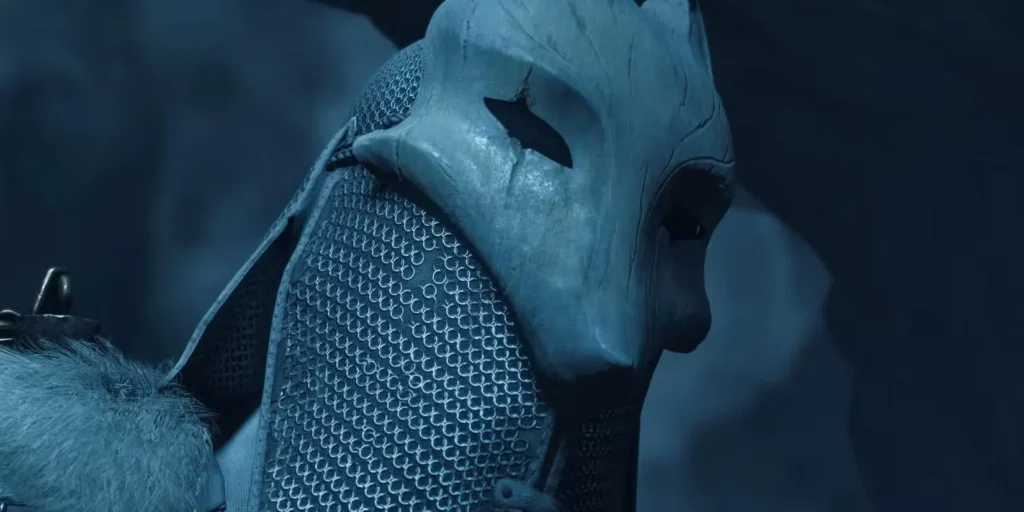
The Snake serves as your introduction to Ghost of Yōtei’s dueling system. Despite being the opening antagonist, he’s deliberately underdeveloped compared to the others. His character embodies vice and cruelty: a man with a silver tongue Lord Saito exploited for recruitment and dirty work the others wouldn’t touch.
By the time you face him, opium has ravaged his body. Yet even intoxicated, he nearly kills Atsu twice during their duel. Imagine what he was at his peak.
When Atsu finally cuts him down, witnesses watch her rise from wounds that should have been fatal. This moment births the legend of the Onryō—the vengeful ghost who cannot die.
How This Boss Feels to Fight
The Snake is all about learning the fundamentals. His attacks are telegraphed but punishing if you panic-dodge. The fight teaches you:
- Perfect parry timing (watch his shoulder, not his sword)
- When to dodge versus when to deflect
- Managing your resolve meter under pressure
Combat Tips:
- Use Water Stance for quick counters after his lunging strikes
- His opium addiction means he occasionally staggers mid-combo—capitalize immediately
- Don’t get greedy; he punishes button-mashing with unblockable ripostes
- His final phase introduces feint attacks—wait for the second swing before committing to parries
Narrative Role: The Snake likely recruited criminals and facilitated the black-market operations funding Saito’s army. His death is less about justice and more about announcing Atsu’s return.
The Oni (Lord Hyōzō): The Vain Warlord of Ishikari Plain
TL;DR: Once a beautiful nobleman obsessed with glory, now a scarred monster who rules through fear. He personally killed Atsu’s father and represents what trauma can corrupt us into becoming.
The Oni is tragedy incarnate.
Before the mask, before the terror, he was Lord Hyōzō—a handsome nobleman chasing glory. A painting Atsu discovers shows what he was: young, beautiful, vain. Then came the Battle of Nagashino.
Shot by a peasant. Trapped beneath his own dying horse. Helpless. Terrified. Powerless.
That battlefield birth the Oni—a man who transformed vanity into weaponized fear. His massive armor doesn’t just protect him; it announces him. The terrifying mask doesn’t just hide the scar young Atsu gave him; it ensures no one ever sees weakness again.
He rules Ishikari Plain through calculated brutality. Burning enemies alive isn’t just cruelty—it’s a deliberate echo of the Night of the Burning Tree, ensuring everyone remembers what happens to those who defy Saito.
The Weight of Murder
The Oni drove his katana through Kengo’s back while Atsu watched. That act defines her entire journey. When you finally face him, it’s not just a boss fight—it’s the moment every step has built toward.
How This Boss Feels to Fight
The Oni embodies overwhelming pressure. His giant odachi creates zones you simply cannot occupy. The fight is about:
- Maintaining composure under relentless aggression
- Finding brief windows in sweeping attacks
- Managing space in his fortress arena
- Coordinating with Jubei during the prisoner rebellion phase
Combat Tips:
- Stone Stance is mandatory—his hyperarmor will trade through lighter stances
- Dodge INTO his overhead swings, not away (the sweet spot is at his feet)
- When prisoners create openings, use heavy attacks to break his posture
- His scar (left eye) is a weak point—attacks from that side deal bonus stagger damage
- Phase 2: He ignites his blade with oil—roll through fire trails, don’t try to block them
Emotional Impact: The co-op kill with Jubei is one of gaming’s most cathartic moments. Two siblings, reunited, bringing down their father’s killer together. The weight of that victory matters more than any mechanical challenge.
The Kitsune: Ghost of Yōtei’s Shadowy Spymaster
TL;DR: A role split between two people—Oyuki (who chose mercy and seeks redemption) and Dojun (her corrupted successor who chose power). The most morally complex members of the Six.
Named after the shape-shifting fox spirit of Japanese folklore, the Kitsune commands the Nine Tails—an elite shinobi network embedded throughout Ezo. But this isn’t one person’s story. It’s two.
Oyuki: The Path of Redemption
Sixteen years ago, Oyuki helped hang Atsu’s mother from the burning tree. She watched a family die. She participated in horror.
Then she made a choice that would haunt her forever: she let young Atsu escape.
That single act of mercy destroyed her. She abandoned the Yōtei Six, became a wandering shamisen performer, and carried her guilt like a second shadow. When she finally joins Atsu’s Wolf Pack, she’s not seeking forgiveness—she knows that’s not hers to claim. She’s seeking to do something good before the weight of what she’s done crushes her completely.
Oyuki forces Atsu to ask: If someone helps you destroy the organization they once served, does that erase what they did? Can redemption exist for someone with blood on their hands?
There’s no easy answer. The game doesn’t give you one.
Dojun: The Corrupted Successor
Oyuki found Dojun nearly feral in the woods, abandoned by his own family. She raised him. Educated him. Showed him kindness.
Then she showed him Lord Saito’s plans. And knowledge became poison.
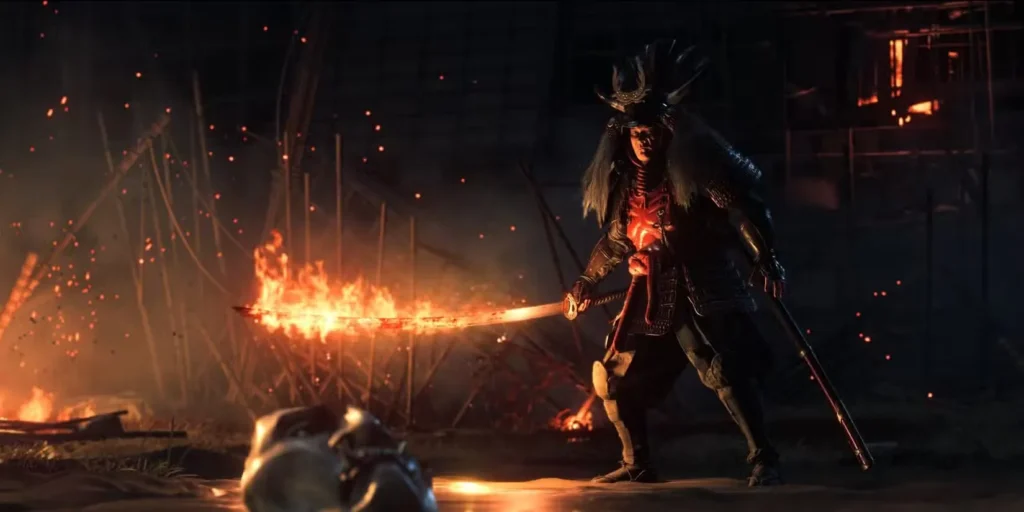
Dojun saw power and wanted it. He became the new Kitsune after Oyuki’s departure—more ambitious, more ruthless, more willing to cross lines his predecessor wouldn’t. He represents the question: what happens when mercy fails? When trying to save someone just gives them tools to hurt others?
Operating from Teshio Ridge, Dojun commands elaborate poison research (specifically wolfsbane toxin) and maintains hidden fortresses protected by coded puzzles. His intelligence network is so effective that he knows Atsu’s plans before she executes them.
When Atsu and Oyuki assault his headquarters, they find the Red Crane Inn destroyed—occupants hung as a message. Dojun knew they were coming. He prepared a welcome.
How This Boss Feels to Fight
Dojun is disorientation incarnate. His reality-bending toxins turn the arena into a nightmare:
- The environment shifts and warps
- Duplicate Dojuns appear and disappear
- Your vision blurs and distorts
- Sound becomes unreliable
Combat Tips:
- Moon Stance excels against his quick, evasive movements
- Focus on the Dojun casting shadows—hallucinations don’t have them
- Antidote charms are mandatory; craft them before this fight
- When vision blurs, listen for his footsteps (audio cues remain accurate)
- Oyuki’s assistance creates safe zones—stay near her when overwhelmed
- His poison clouds can be dispersed with Wind techniques
Thematic Mechanic: The hallucinations aren’t just difficulty—they represent Dojun’s worldview. He’s so consumed by deception that reality itself bends around him. Fighting him means maintaining your grip on truth while he tries to drown you in lies.
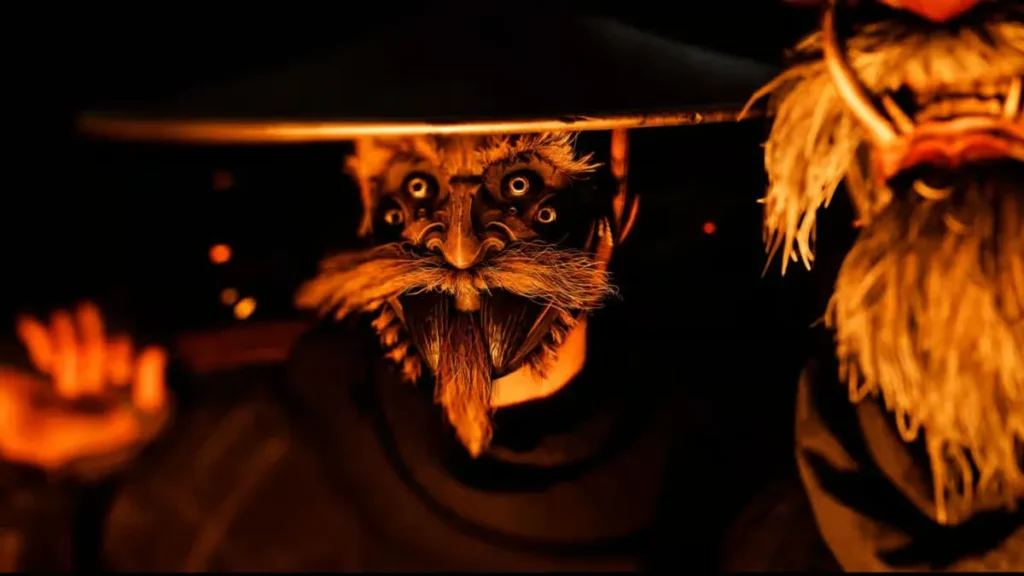
The Spider and The Dragon: Lord Saito’s Conflicted Sons
TL;DR: Two brothers destroyed by their father’s impossible expectations. The Dragon seeks approval through obedience; the Spider survives through betrayal. Both wield firearms instead of swords—mercenaries, not samurai.
Lord Saito’s sons represent two responses to an abusive father: desperate loyalty and bitter survival.
The Dragon: The Favored Firstborn
Saito gifted his personal katana to the Dragon with a warning: “Disappoint me, and I’ll use this blade against you.”
Imagine receiving your father’s love as a threat.
The Dragon is more honorable than his brother, more disciplined, more controlled. He’s also more trapped. Every choice he makes is calculated to earn approval that never quite arrives. When their forces were wounded in battle, he refused to abandon his brother—an act of loyalty Saito deemed shameful weakness.
The Dragon wanted to be a good son. His father made that impossible.
The Spider: Survival Through Cowardice
Where the Dragon sought love, the Spider accepted hate and learned to weaponize it.
Labeled “the son of a tyrant,” he openly undermines his father’s orders. He mocks. He deconstructs. He survives by being too unpredictable to trust with anything important—and therefore impossible to punish when things go wrong.
His cruelest act: staging a theatrical reenactment of the Night of the Burning Tree as entertainment. When Atsu discovers this, something breaks inside her. She slaughters his forces in berserker rage while he laughs from a safe distance.
The Spider understands something his brother never learned: their father doesn’t reward loyalty. He rewards results. And the best result is staying alive.
Why the Spider Survives
When the Dragon dies at Matsumae Castle, the Spider faces execution. He does what he’s always done: he betrays someone to survive.
He offers to lead Atsu to Saito’s fortress. His father disowns him for failing to protect his brother. Atsu spares him because his cowardice makes him pathetic rather than dangerous.
The Spider endures because he never pretended to be honorable. He’s the only member of the Six who understands that survival requires abandoning the honor that destroys everyone else.
How These Bosses Feel to Fight
The brothers represent distance and evasion. Unlike traditional samurai duels, they refuse close combat:
- Constant repositioning across multi-level arenas
- Sniper shots from elevated positions
- Explosive traps and environmental hazards
- Tag-team coordination (when fought together at Matsumae Castle)
Combat Tips – The Dragon:
- He WILL scope long shots—watch for the glint and break line of sight immediately
- Moon Stance for gap-closing against his retreats
- Use smoke bombs to approach safely across open ground
- His modified rifle overheats after three rapid shots—push during reload
Combat Tips – The Spider:
- More erratic than his brother—fights dirty with flash bombs and caltrops
- Predicts your approach routes and pre-traps them
- Kunai into rifle shot combos—dodge the kunai, deflect the bullet
- He WILL flee when low on health; chase aggressively or he’ll reset the encounter
Combat Tips – Fighting Both (Matsumae Castle):
- Prioritize the Dragon—the Spider’s morale breaks when his brother dies
- Use architecture to split their sightlines
- Ghost weapons (especially smoke) are essential
- Bring the Heavenly Strike technique for burst damage opportunities
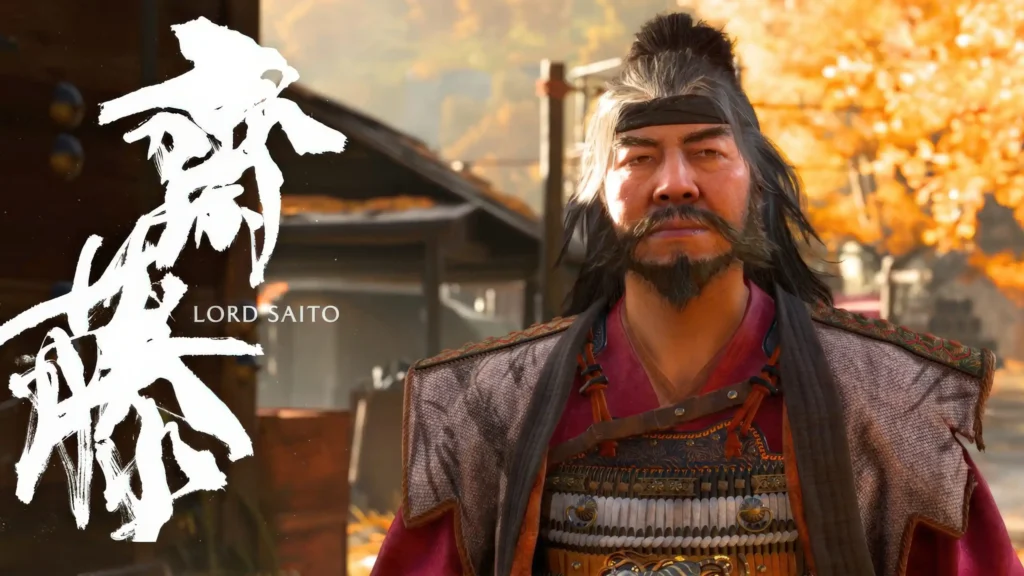
Lord Saito: The Fallen Warlord and Primary Antagonist
TL;DR: An exiled nobleman consumed by the need to rebuild what he lost. His family starved in Ezo, so he built a new clan on their graves. The mirror showing Atsu what she’ll become if revenge consumes her.
Lord Nariaki Saito is what happens when grief calcifies into purpose.
Once leader of Clan Saito, allied with Oda Nobunaga during Japan’s unification wars. When overwhelming forces crushed his allies, he fled north to Ezo with his family. The escape was hell. His wife became pregnant during the flight.
They reached Ezo. Then his family starved.
Wife. Daughter. Unborn child. Dead because he couldn’t protect them in exile.
The Warlord’s Terrible Logic
Saito swore revenge against the Shogun and the retainers who betrayed him. But more than that—he vowed to rebuild his clan in the north under absolute control. Never again would weakness doom those under his protection.
That logic led directly to the Night of the Burning Tree.
When Kengo deserted, Saito faced a choice: mercy or example. He chose example. One family’s death to prevent the clan’s collapse. Cruelty in service of survival.
He expresses genuine regret when speaking to Atsu. He calls her “little wolf.” He mourns what necessity forced him to do. And then he justifies it through honor: discipline required sacrifice.
Saito isn’t lying about his regret. That’s what makes him terrifying. He genuinely believes he had no choice.
The Shogun of the North
Saito doesn’t hide behind a mask like the others. Tiger motifs dominate his armor—the predator claiming his territory openly. His ambition is absolute: unite all of Ezo under Saito rule. Become Shogun of the North.
He commands the Yōtei Six, the Nine Tails shinobi, regular soldiers, and ronin mercenaries. He builds a secret fleet to assault the Matsumae clan. He orchestrates abductions, manipulates politics, and crushes resistance with methodical efficiency.
Unlike his sons who use firearms or the Oni who wields a greatsword, Saito fights with dual katanas—traditional weapons befitting nobility. He refuses modernity’s shortcuts. If he’s building a new clan, it will be built on samurai principles.
Even if those principles require atrocity.
How This Boss Feels to Fight
Saito is mastery tested. Everything you’ve learned faces final examination:
- Lightning-fast dual-blade combinations
- Seamless stance switching mid-combo
- Perfect parry timing requirements (no spam-parrying works here)
- All four elemental techniques used against you
- Environment shifts as the fight progresses
Combat Tips:
- No single stance works—you MUST adapt as he adapts
- Watch his stance shifts; they telegraph his next attack pattern
- His dual katanas can attack high and low simultaneously—jumping sometimes beats dodging
- Phase 2: He abandons restraint and uses Ghost weapons (he considers this dishonorable but necessary)
- Phase 3: Activates Resolve techniques—if you see him glow, interrupt IMMEDIATELY or face devastating damage
- When he sheathes both blades, prepare for Heavenly Strike (perfect parry timing or die)
The Burning Tree Arena:
- The fight occurs beneath the same ginkgo tree where it all began
- Burnt ground limits movement
- Emotional weight affects performance—stay focused despite the symbolism
- Jubei assists until Saito mortally wounds him—music shifts when this happens
Victory Condition: Break his posture three times while managing your own health against his overwhelming offense. The duel rewards patience, adaptation, and mastery of every combat system the game has taught you.
The Night of the Burning Tree: Genesis of the Yōtei Six Conflict
TL;DR: The massacre that started everything. Saito made an example of Atsu’s family to prevent desertions. Young Atsu survived impossible wounds, beginning her legend as the Onryō.
Sixteen years before Ghost of Yōtei begins, Lord Saito made a choice that would define everyone’s fate.
The Deserter
Atsu’s father Kengo was a soldier in Clan Saito. He deserted because Saito ordered village raids—desperate attempts to feed a starving clan in exile. Kengo refused to terrorize innocents for survival.
Saito encountered Atsu and Jubei innocuously in the forest. The children invited him home. When he met Kengo, the full truth emerged.
Saito announced he must “make an example” of this family. Mercy would inspire more desertions. The clan couldn’t survive if soldiers valued personal morality over collective survival.
The Yōtei Six arrived at their home that night.
The Massacre
What happened:
Young Atsu grabbed her father’s katana and struck the Oni across the face. The blade scarred him permanently—a wound he would hide behind a terrifying mask for sixteen years.
The Oni recovered and drove his katana through Kengo’s back. Atsu’s father died in front of her.
Jubei tried to fight. The Oni grabbed him and threw him aside. The boy fell badly but survived—though everyone believed him dead.
The Spider and Dragon separated the fleeing children with gunfire. Jubei was shot and fell off a cliff. Oyuki (the Kitsune) had a choice: kill young Atsu or let her escape. She chose mercy and let the girl run.
But Atsu couldn’t run far enough.
The Snake caught her. He pinned her to the burning ginkgo tree using her father’s own katana. While the tree burned around her, Lord Saito hung Yone (Atsu’s mother) from a branch of that same tree.
In Atsu’s final moments—or what should have been final—her mother sang to comfort her dying daughter. Yone’s voice remained calm even as her own life ended.
Then something impossible happened.
Atsu survived wounds that should have killed her. When witnesses discovered her alive, the legend began: the Onryō, the vengeful ghost who cannot die.
Why This Matters
The Night of the Burning Tree isn’t just backstory. It’s the lens through which every character views their choices:
- Saito sees necessary sacrifice for the greater good
- The Oni remembers the scar and the shame of being wounded by a child
- Oyuki carries lifetime guilt for her participation and the mercy that haunts her
- The Snake represents thoughtless cruelty—he probably doesn’t even remember her specifically
- The Spider later stages it as entertainment, mocking the trauma
- Atsu built her entire identity around this night
The massacre created the Onryō. The Onryō will destroy the Yōtei Six. But destroying them won’t resurrect the dead or heal the trauma.
That’s the tragedy the game builds toward: revenge can’t fix what broke.
Thematic Significance: When Revenge Becomes You
The Yōtei Six aren’t defeated because they’re evil. They’re defeated because they refuse to stop becoming it.
The Mirror Effect
Each member shows Atsu a possible future:
- The Oni: What trauma transforms you into when you embrace fear
- Dojun: What happens when you choose power over principles
- The Dragon: What desperate loyalty to a corrupt authority destroys
- The Spider: What survival looks like when you abandon all honor
- Saito: What obsessive revenge becomes after achieving it
Oyuki represents the alternative: someone who participated in atrocity and chose redemption over continued corruption. Her presence asks whether that path is even possible.
The Central Question
Can someone who helped murder your family earn forgiveness by helping you destroy the organization they served?
Ghost of Yōtei doesn’t answer this. Atsu’s relationship with Oyuki remains complicated through the entire game. Forgiveness isn’t a switch you flip—it’s a wound you decide whether to keep reopening.
The Cost
Destroying the Yōtei Six costs Atsu her brother. Jubei dies in the final confrontation with Saito. She achieves her revenge and loses her family again.
The game’s final choice isn’t about whether to kill Saito—that’s inevitable. The choice is what Atsu becomes after: does she continue hunting enemies, or does she become guardian to her niece Kiku?
Revenge can’t resurrect the dead. It can only create more ghosts.
The Final Reckoning: Defeating the Yōtei Six
After the Snake falls in the opening, you have freedom. Hunt the Oni for emotional payoff. Track Dojun for the most complex boss fight. Chase the brothers for mid-game progression.
Eventually, all paths lead to Saito.
The Ultimate Showdown
The final battle occurs beneath the burning tree where it began. Before the duel, Atsu burns the sash bearing the Six’s names—accepting that revenge alone cannot fill the void.
Saito fights with everything he withheld before. He mortally wounds Jubei. The siblings overcome him together, giving the warlord a warrior’s death despite his crimes.
In his final moments, Saito achieves the honor he always craved: dying in combat rather than assassination. But this victory is soaked in Jubei’s blood.
What Victory Means
The Yōtei Six’s destruction resolves the immediate conflict. It doesn’t undo trauma. It doesn’t resurrect anyone. It doesn’t heal Atsu.
Her real journey begins after they fall: moving from vengeance-obsessed ghost to guardian of the living. Destroying enemies is easier than rebuilding yourself.
The game ends with Atsu holding her niece, having lost her brother to achieve revenge she can’t even celebrate. She’s alive. She’s won. She’s utterly hollow.
The Yōtei Six die. But the ghost they created outlives them all.
Frequently Asked Questions (FAQs)
Who are the Yōtei Six in Ghost of Yōtei?
What is the Night of the Burning Tree?
In what order should you fight the Yōtei Six?
Who killed Atsu’s father in Ghost of Yōtei?
Is Oyuki the Kitsune in Ghost of Yōtei?
What weapons do the Yōtei Six use?
Why did Lord Saito massacre Atsu’s family?
Does Atsu kill all the Yōtei Six?
What is Lord Saito’s ultimate goal?
Who are the Nine Tails in Ghost of Yōtei?
What happens to Jubei in the final battle?
Can you spare any of the Yōtei Six?
What stance works best against each boss?
Oni: Stone Stance (required for hyperarmor trades)
Kitsune (Dojun): Moon Stance (evasive movements)
Spider & Dragon: Moon Stance (gap closing)
Saito: All stances (must adapt constantly as he switches)
Is there a recommended level for fighting each boss?
Additional Resources & References
Official Sources:
- Ghost of Yōtei Official Website – Latest updates and patch notes
- Sucker Punch Productions – Developer insights and dev diaries
Community Resources:
- Ghost of Yōtei Wiki – Detailed boss strategies and build guides
- r/GhostOfYotei Reddit – Community discussions and tips
- IGN Ghost of Yōtei Guide – Video walkthroughs
Note on Post-Launch Changes: Legend Mode difficulty (added in Patch 1.2) adjusts boss health pools and parry windows. Consult current patch notes for mechanical changes affecting strategies listed in this guide.
The Yōtei Six aren’t just obstacles to overcome—they’re questions you can’t avoid answering. Each duel asks: Are you executing justice or feeding the same cycle that created them?
Atsu crosses every name off her list. She achieves her revenge. And in the end, she’s left holding her brother’s orphaned daughter, wondering if any of it mattered.
The Six die. The ghost remains.
That’s the story Ghost of Yōtei tells.